Benefits of Purchasing High End Sim Equipment
One may consider high end as going for a complete system with a tons of bells and whistles all at once.
Personally, this is a decision that can lead to most of the benefits with some shortcomings for the routine sim racer who depends on precision and details to be better at everything.
Going from a Sim Racer to Amateur racing driver is focused on a few metrics that can be developed in a time span with the right people to support your mindset and provide resources to get you to have realistic practices that fit the sport. Sim racing exists in a vacuum that’s entirely digital, don’t consider the real thing without proper goals in mind.
As a pro-amateur driver, you're probably racing in real-life club-level, regional, or even national series (e.g., Spec Miata, GT4, TCR, etc.), and using sim racing for:
Skill development & muscle memory
Track learning & race preparation
Staying sharp in off-season
Competing in high-level esports events
The closer the sim setup mimics real car dynamics, the more valuable it is — both for real-world transfer and virtual competition.
When specifications come to mind, orientation in 70% of the battle. The remaining 30% makes a significant different when it comes to achieving excellence however.
Consider your options for simulation hardware as the ceiling for realizing potential during practice where time commitment is a significant investment.
Major components that exists in the frame of the simulator consist of the following:
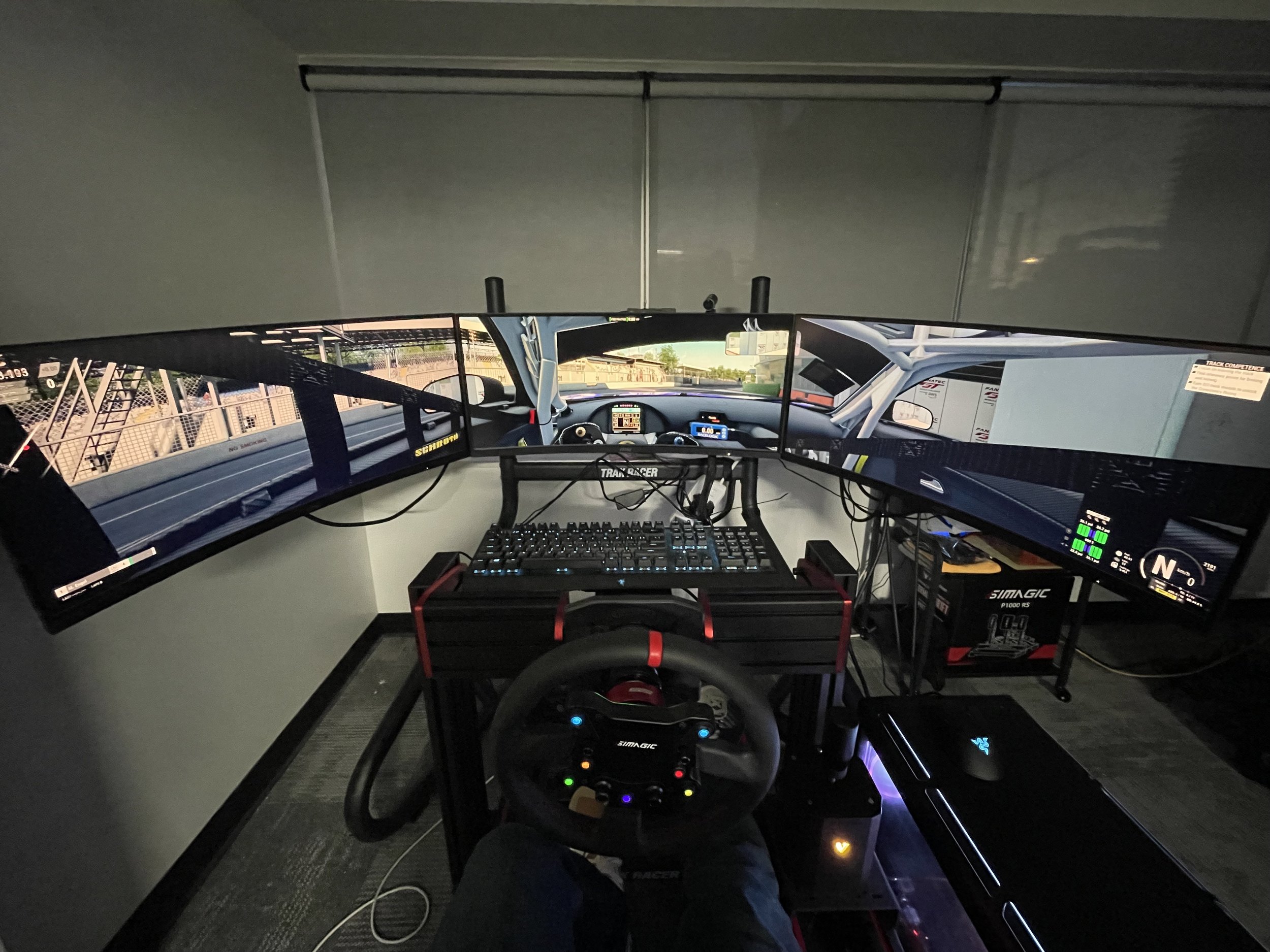
Wheelbase
Why It Matters:
The wheelbase is the motor that powers your steering wheel. Higher-end direct drive (DD) bases (like Simucube 2 Pro, Fanatec DD2, etc.) offer:
High Torque (10–25 Nm+)
Replicates the steering weight and forces of a real car
Lets you feel how grip builds and fades at the limit
Crucial for understanding front-end traction, understeer, and steering corrections
High Resolution & Low Latency
FFB Motor orientation aligned with arm rotation for ergonomics
Responds swiftly to micro-inputs with precision
Configurable resolution up to 240000 bits
Response time of 1 ms
Resolution frequency up to 40 kHz
Helps detect subtle road texture, kerb feedback, and tire behavior
More immersive, and more importantly, more actionable feedback
Consistency Across Sessions - Direct drive systems don’t fade or fluctuate like cheaper belt-driven wheels
Enables muscle memory training for car control
Pedal Set
Why It Matters:
Braking is arguably the most important aspect of lap time and car control. High-end pedal sets (e.g., Heusinkveld, Simgrade, MECA) offer:
Load Cell or Hydraulic Brakes
Replicate the feel of brake pedal pressure (in Force, not just travel) - important for muscle memory
Train your foot to apply consistent, progressive pressure — just like in a real car
Develop trail braking skill accurately
Customizability (Pedal Force, Travel, Curve)
Mimic the feel of pressure applied in race segment specified vehicles using load cells or low cost hydraulic systems
Imitates responsiveness of hydraulic systems designed for segmented race series defined by the authoritative body e.g. FIA defined GT4, TCR and amateur-only Sports Car
Important for building consistent habits that transfer between sim and real-world
High Resolution & Minimal Latency
No input lag or sensor inaccuracy
Every millimeter of pressure counts, especially in threshold braking zones
"In sim racing, you’re not getting the g-forces or body cues — your brake pedal becomes your main sense of deceleration. The better it is, the more confident and consistent you’ll be."
CPU System
This key component has many features that allow you to truly get an edge on everything your are looking to develop.
Key features that will allow you develop the keen eye on driver education concepts beyond just practice is the research necessary to be aligned with the best in the segment.
Industry best software for High Performance Driver training features e.g. Asseto Corsa
Data management tools
AI coaching software like “Crew Chief”
Credential management for various platforms and servers
Audio Equipment
You have the option for Speakers or surround sound headphones.
Both allow you to interact with the simulation on a different level
Only one option for headphones will give you the ability to close the loop with a communication channel to AI and other players.
Haptics
Simulation details the road texture and harshness when wheel pressure and stability comes into effect
Feedback also occurs where various load bearing systems have been specified to give a notification by means of force at the pedal or steering that a reactive force or pressure is present and is causing some limitation of output where wheel speed and differential is concerned.
Multiple devices are offered to deliver realistic pressure, the optimum setup depends on your strategy and desire for a detailed experience that allows your senses and practices to be finely tuned for the segment.
Widescreen Display
Perhaps as critical as anything else are the senses that allow for visibility between the driver and the field of view to other sim racers, NPC, and road features.
VR or External monitor - your choice is based on comfort, ergonomics and accessibility
The boundary of ergonomics will be limited as VR can be less cumbersome, more detailed and easier to handle that the external widescreen display.
External monitors are hands free the driving, give less opportunity for wear and tear and ergonomics of motion sickness is not an issue in most cases.
A good wheel based allows you to feel every logical function of vehicle physics so there is little guesswork in how you understand the dynamics. It’s not about luxury, it’s about performance. Most other features, are a matter of stylistic preference and ergonomics. Indeed, having too much can be distracting.
The system software takes runtime data from Spec vehicles and race design applications to create virtualized models in the Gaming physics engine. These Physics engines harness computing power to imitate the environments and achieve simulated realism close to the real thing.
Programming every part of the vehicle geometry and systematic software functions, force and 3rd party technology applications to provide added value for the driving experience.
The imitation gaming industry recognized the need for high end simulation hardware for the consumer sim racing the fidelity of the software application.
The cost of entry is that $200 Logitech pedal and steering wheel set.
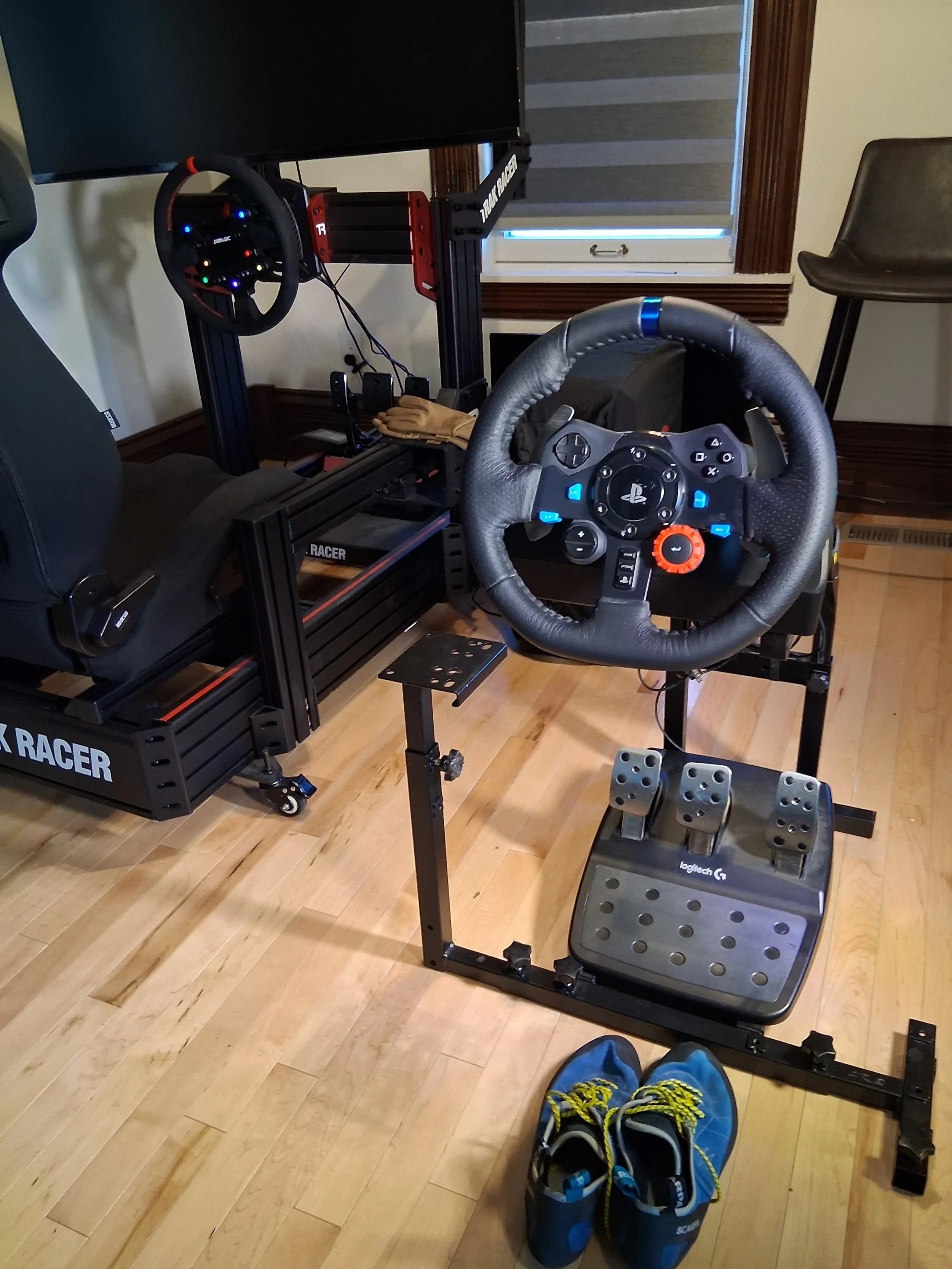
Fidelity is everything in this situation.
A complete system with added value of high fidelity inputs from Sim Racing equipment will add a factor of value that is dwarfed by the cost of owning a vehicle similarly equipped for sports purposes. On the other hand, it is priced well above the value of an entry level sim arcade which the manufacturers are well aware of. It’s not that a the entry level equipment is not built for durability, on the contrary, they last quite a long time in consumer hands. The difference is in the quality and clarity of the inputs. Stay tuned for future articles where we get into those details. In the meantime..
A true testament to where the tech has arrived in the modern era is you can have a very high resolution toolset with reasonable costs that a amateur to semi pro to appreciate around ten thousand dollars in most cases.

To put that into perspective, that is less than the cost of a vehicle, entry into a road course and a many days short of an all nighter trying to setup the suspension geometry and engine tuning in just the right fashion.
Not saying you don’t need to do that stuff anyway, however, it will be much less intimidating starting out. Just ask our neighbors up north in Ottawa, they don’t leave their house without plowing snow for close to half the year. Testing may be delayed as a result. If you can’t work it out in your calendar, get a sim rig in the colder months.
Avoid the frustration and look for key components to have a frustration free set of years that will make memories happen with your friends and even family where they get involved in your new hobby, Sim Racing.
Sincerely yours,
Mike
VelocityXperience