Innovation is Cleaning up emissions with Engine Oils
To celebrate Earth day in 2026, let’s take a look at what matters to the environment and our global community. As of recent news, we are flying past the Moon and as well as discovering new frontiers.
As always, this story starts where you are and without consideration for what it costs. Most Americans have a means of getting to work and on average in American Cities, that is by car. The average distance to commute rose from 10 to 27 milesbetween year 2010 to 2027 based on a report from HR management software provider Gusto.
Driving a commuter car is more about getting from point A to point B than anything else. How much you spend and how efficient the fuel burn makes the difference not only by cost but also by comfort, smell and general community wellness. As a global community, one can do well by considering the tailpipe emissions and company initiatives to reduce carbon emissions when making a purchasing decision. This is a differentiator that drives smart decisions as the auto manufacturer looks forward in history alongside their competitors amid market changes.
Having the opportunity to get into driving for amusement purposes is second best to mobility in general. Most people who live in a city attest to not needing a car at all due to simple convenience of having other options. What is unique about the last ten years of innovation is that any new vehicle is much better at managing fuel consumption than ever before. One can optimize that even further by buying a hybrid or even fully electric vehicle to find gains of convenience and comfort in how they travel.
Emissions reduction can cause some increased efficiency in high occupancy with maximized gains with most commuter vehicles. This is a personal preference that the automotive industry has been optimizing scientifically and from an engineering perspective very meticulously for the last ten years.
The foundation of this initiative was set off in 2015 for the next generation of engine oil detergents and carbon-based fuels. with the oncoming 2026 motorsports season, there is a significant transition in fuel sourcing that is entirely synthetic and promises significant reduction is emissions.
Thanks to the process of fuel production and the materials sourcing from renewables, this is an engineering innovation worth considering once it becomes a market staple.
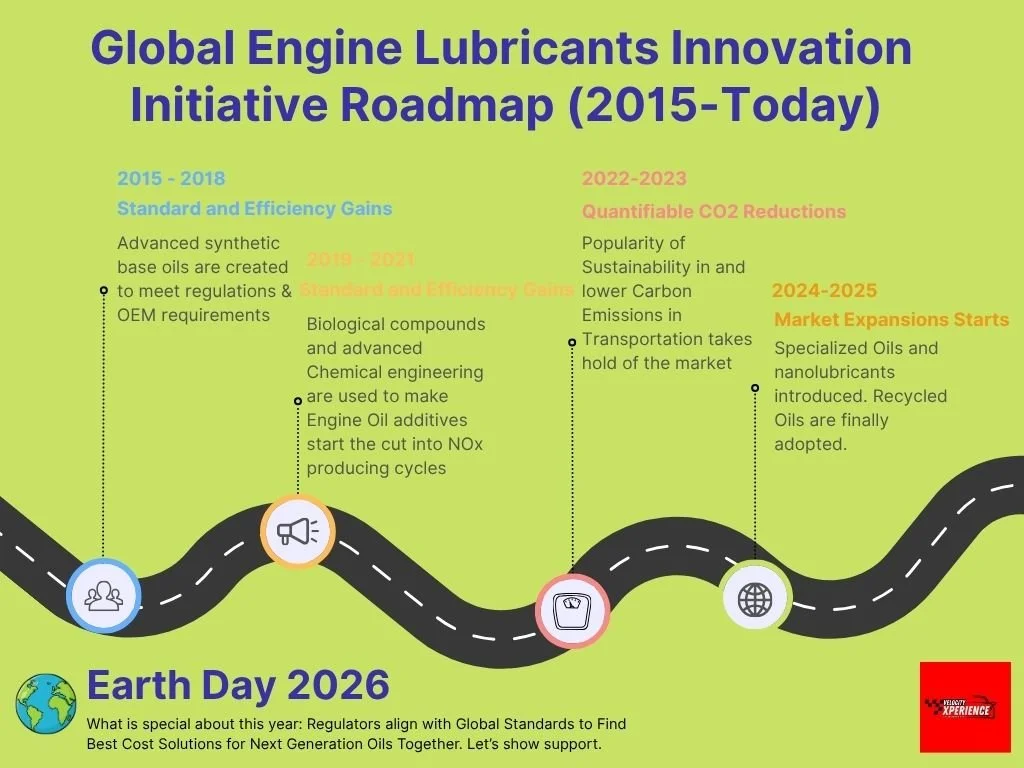
Earth Day Poster 2026
VelocityXperience details innovations in Engine Oil Lubricants that cut Carbon emissions and boosts fuel economy for commuters
In Detail - Engine Oil Innovations from 2010-Now
2015-2018: Foundation and Early Efficiency Gains
Advanced synthetic base oils
OEM requirement shifts
2019-2021: Sustainabilty from Bio-engineered oil Focus Emerges
Bio-Based lubricants and bio-chemistry
Additive Innovation
2022-2023: Quantifiable CO2 & Lifecycle reductions
Popularity of Sustainability in the Market
Low-carbon base oils
Nanolubricants
2024-2025: Market Expansion & Product Commercialization
Specialized low-viscosity oils are further refined
Bio-Based and recycled oils are adopted to create lower tailpipe emission
Regulators align with global standards to find best cost solutions for next generation oils together
Outcome: Larger power outputs and efficiency in the fuel mixture requires that specific engine tuning and engine design be taken into consideration.
How do you show support?
Buy the newer synthetic blends,
change your oil every 5-10,000 miles
come back to VelocityXperience.net for more developments as we finish
The Standard, automotive maintenance guide
Stay tuned for more information regarding the interesting innovations in Automotive Tech.
References: Report of Commuting in the United States, Census Bureau, 2022, https://www.census.gov/topics/employment/commuting.htmlAmericans Now Live Farther From Their Employers, Merk Akan, 2024, https://gusto.com/resources/gusto-insights/americans-now-live-farther-from-their-employersMaximize Fleet Efficiency, Karin Haumann, 2025, https://www.fleetowner.com/perspectives/ideaxchange/blog/55275232/maximize-fleet-efficiency-the-crucial-role-of-lubrication-in-reducing-fuel-costs-and-emissions